Tuesday, 7 July 2015

PURE Multi Media Environmental Awareness Exhibition

Coláiste Bhríde students participating in PURE MUSIC competition

The PURE (Protecting Upland and Rural Environments) project is hosting a Multi Media Environmental Awareness Exhibition in the Courthouse Arts Centre in Tinahely on the 12th July which will run for a period of 3 weeks.  The exhibition concentrates on the various multimedia projects PURE has produced to create environmental awareness, featuring 16 award winning short environmental animations, 7 environmental music videos, a short film on the community/environmental initiative, the PURE Mile and short films on illegal dumping in the Wicklow/Dublin uplands.

The exhibition opening will also include the first public screening of the recently completed primary school project entitled PURE WISDOM.  This short documentary interviewed and filmed 24 junior and senior students (4 to 6 years old) from Kilcommon National School in Tinahely, Co. Wicklow and asked for their opinions and thoughts regarding the environment, illegal dumping, litter, pollution and nature.  The interviews form an insightful 12 minute production which is both humorous and wise.

At the launch of the exhibition PURE will also announce the winners of the first PURE MUSIC competition.  The 6 secondary schools from Wicklow, South Dublin and Dún Laoghaire who completed the PURE MUSIC environmental training programme are competing for the prize of a one day professional recording session at Temple Lane Studios in Dublin where acts such as Snow Patrol, Kanye West, Rihanna and Morrissey have recorded.  Renowned Irish musician and PURE MUSIC judge Dave Hingerty will present the prize to the winning group.  Dave has played with The Frames, Josh Ritter, The Swell Season, and most recently Irish band Kila, composers of the original music score for this year’s Oscar nominated feature animation, ‘Song of the Sea’.

For further information visit  www.pureproject.ie


Author: Ian Davis, PURE Project Manager

Wicklow Tourism Businesses Meet with Fáilte Ireland to progress ‘Ireland’s Ancient East’

Noel Keyes (Wicklow County Tourism), Jenny De Saulles (Head of Ireland’s Ancient East Programme, Fáilte Ireland), Michael Nicholson (Wicklow County Council) and Martina Robinson (Wicklow County Tourism) at the recent workshop in the Amber Springs Hotel, Gorey. 

Tourism operators from Co. Wicklow attended Fáilte Ireland’s initial Ireland’s Ancient East stakeholder workshop at the Amber Springs Hotel, Gorey, Co Wexford, on 12th May to learn more about the new initiative and to discuss how they can work with the national tourism authority to bring this new tourism initiative to life in the East and South region.

 
Ireland’s Ancient East is a new touring region which seeks to attract greater international visitors by building on the wealth of historical and cultural assets in the east of Ireland.  This new initiative, which includes County Wicklow, extends from Carlingford to Cork and Cavan to Carnsore and is based on 5,000 years of history, heritage and culture all located in a relatively compact region.

 
Speaking at the meeting, Fáilte Ireland’s Head of Programmes for Ireland’s Ancient East, Jenny De Saulles, explained: “The key to the initiative’s success will be how local history is illuminated by local people, communities and tourism stakeholders.  To that end, Fáilte Ireland is meeting and working with local interested parties over the coming months to enlist their support and expertise to bring the project to life and our tourism partners in County Wicklow have a key role to play in that regard.”

 
Following comprehensive research in overseas markets, the initiative will be aimed at specific overseas market segments who have indicated they would be more likely to come to Ireland to take in history and culture, explore new landscapes and to connect with local heritage and nature.  The proposition will be crafted along four distinct thematic pillars - Ancient Ireland, Early Christian Ireland, Medieval Ireland and Anglo Ireland.  

Ireland’s Ancient East is an evolving project on which work is now beginning to prepare for the tourism season next year.  In the months ahead, investment in a major signage programme and supports for attractions and heritage sites will be rolled out.

Author: Laoise Donnelly, Press Officer, Fáilte Ireland

Monday, 6 July 2015

A Plan for Improved Management of Upland Habitats


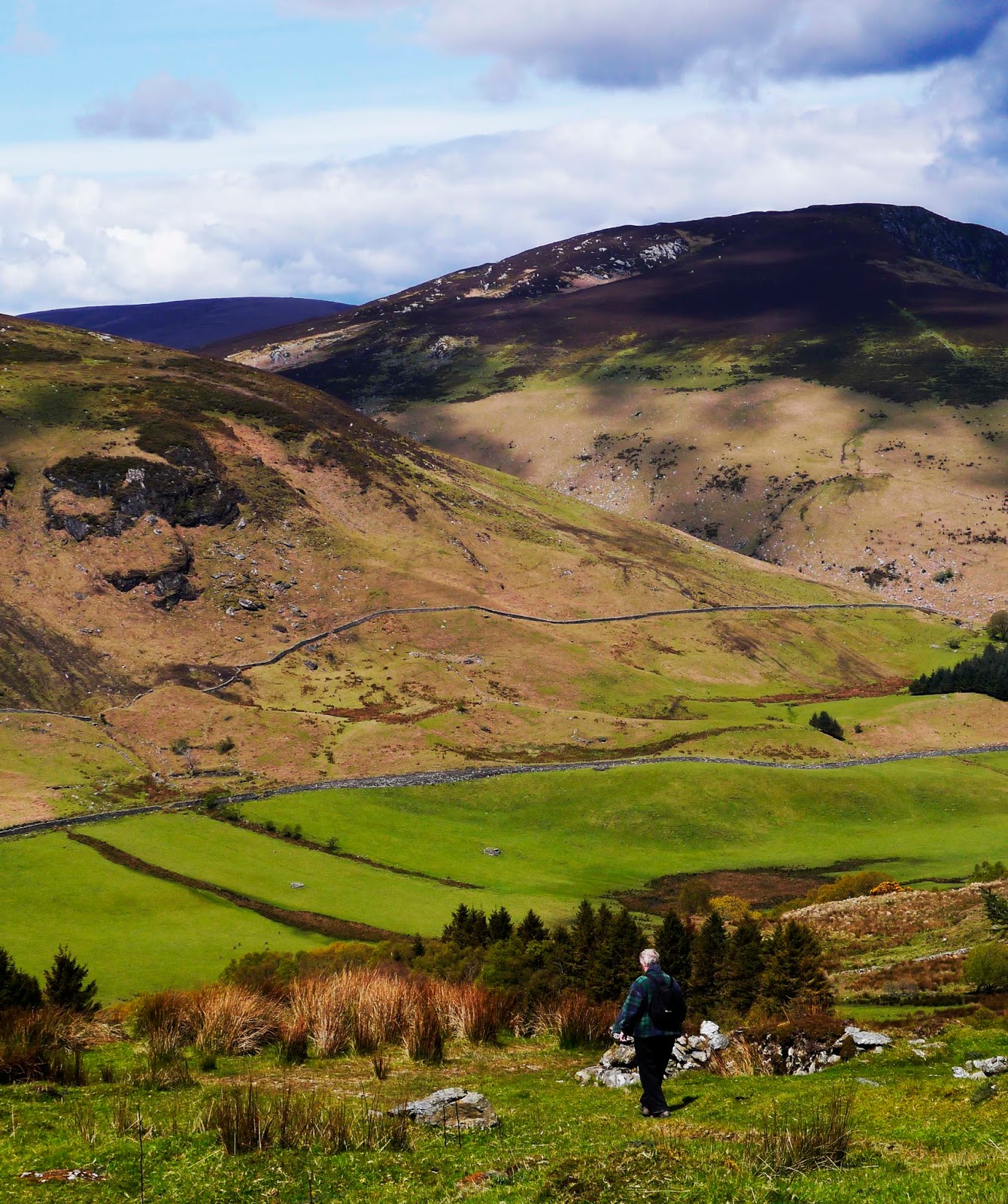
Our hill farmers have shaped the landscape and biodiversity in the Wicklow uplands over the past 6000 years.  With appropriate management systems, farming has the capacity to continue to provide optimal conditions for upland biodiversity.  However there has been a steady decline in hill sheep farming in recent years.  This is now associated with under-grazing in some areas leading to a threat to certain types of biodiversity and the accumulation of unmanaged upland vegetation, mainly bracken, heather and gorse.

As witnessed over the past few months this build-up of fuel poses a serious health and safety risk to people living and recreating in the hills and our cherished wildlife and upland habitats.  The special nature of the area is recognised by c30,000 hectares of the county now designated as a Special Area of Conservation with the Wicklow Mountains National Park at its centre.  Wildfires also pose a serious threat to forest properties (c21% of County Wicklow) across the uplands many of which adjoin the open hill.

In 2011 a Working Group was established by Wicklow Uplands Council to tackle the issue of vegetation management.  Representation on the Working Group includes Wicklow hill sheep farmers, recreational users, Teagasc, NPWS, Wicklow Uplands Council and the Irish Uplands Forum.   Over 30 meetings and site visits took place over a period of three years examining management issues and gaining an understanding of the perspectives of the key stakeholder groups.  In 2013 ‘A Study to Identify Best Management of Upland Habitats in County Wicklow’ was commissioned by Wicklow Uplands Council and launched by the Minister for Agriculture Simon Coveney.  The need for support for management of hill areas was clearly identified and a locally led Sustainable Upland Agri-Environmental Scheme (SUAS) was proposed with detailed key management prescriptions.  The full study is available on www.wicklowuplands.ie.

The review of the Rural Development Programme (RDP) in 2013/2014 was very timely in this regard and the Wicklow Working Group alongside a National Uplands Group lobbied for the provision of a Locally Led Environmental Schemes under Pillar II.  The option for Locally Targeted Schemes was successfully included in the RDP and they will sit on top of the GLAS Scheme and the Basic Payment Scheme in a tiered structure.

In May 2015 the Working Group representatives met with Rural Development Programme officials at the Department for Agriculture, Food and Marine to further discuss the proposal for the Wicklow uplands.  They welcomed the Wicklow proposal and advised that an official call for applications for a competitive process will be issued in autumn 2015.  Wicklow Uplands Council will be developing our application over the coming months and is hopeful of securing funding.  The local schemes are expected to be operational by 2016.

A fundamental feature of the scheme proposed for Wicklow is the development of management plans for upland farms.  They will be prepared with input from upland ecologists, farmers and farm planners.  They will be based on initial habitat mapping and habitat condition assessments and will specify where and what actions are necessary to enhance habitats and protect key species.  While most actions will relate to grazing management, plans may also specify controlled burning with maps clearly identifying areas that are suitable on a rotational basis and areas which are unsuitable for burning such as blanket peat, bracken and areas with vulnerable species.  Controlled burning would be carried out by a trained group ideally with the support of the relevant authorities, the Fire Service, Gardaí and NPWS and with careful regard for neighbours and visitors.

It must be recognised that there is a significant difference between the devastation caused by uncontrolled wildfires compared with the use of controlled rotational burning which provides forage and shelter for sheep while creating a mosaic of habitat structures and food for wildlife.

Undertaken responsibly, controlled burning is an important management tool in the future of upland habitat management together with subsequent appropriate stocking levels on the hills.  This is a unique opportunity for upland farmers and ecologists to work together to provide the optimal result for upland habitats in County Wicklow while keeping hill farming alive and avoiding abandonment of the Wicklow uplands which is not in the interest of anyone.

Wicklow Uplands Council wishes to present a balanced view of local issues and how we are attempting to overcome them by working in partnership and presenting the perspective of the people who have lived, recreated in and worked the hills for generations.

Author: Lenka Mulligan, Communications Officer, Wicklow Uplands Council